Chennai, on India's southwest coast, is India's deep southern metropolis. Chennai was known in British colonial times as Madras, and the surrounding state, now Tamilnadu, was formerly Madras State. Chennai offers plenty to do and see; I remember many interesting times there from my youth. But a jet-lagged, sleep-deprived, just-arrived foreigner first notices Chennai's busy-ness, heat, noise, wandering animals, and frantic traffic.
Having just flown from Minneapolis to Chennai, via Paris and Bangalore, in March 2012, my daughter and I did the prudent thing: We headed directly from the airport to the peaceful, quiet, clean Ideal Beach Resort, about an hour's drive down the Bay of Bengal coast.
The traffic was intense all the way, but it didn't stop this little girl from conking out on the gas tank of Dad's motorcycle. Not visible is Mom, riding side-saddle behind, and another sibling sandwiched between the parents.

Animals often share the road with vehicles. This cow is on the main highway from Chennai to Pondicherrry, an important city further down the coast. Note the so-called auto-rickshaw on the other side. These contraptions often carry 5 or 6 passengers.


Elsewhere in Mahabalipuram town are several other sculptural sites, contemporary with the shore temple but a little inland and hence much less weathered. One of the most spectacular is the Five Rathas. All five house-like structures and several animal figures were supposedly carved, not built up, from one immense rock outcropping.

The Five Rathas site points to a story in the Mahabharatha. The famously beautiful and floral-smelling Draupadi married five noble brothers, the Pandavas, who collectively (individually would be asking too much) embodied five important husbandly virtues.
Here is Draupadi among her husbands.

At yet another site in Mahabalipuram are very detailed bas-relief carvings, in solid rock, of episodes from the Hindu scriptures. The scene below involves Krishna, cows, and a great many female cowherds.

The carvings are intricate and charming, with elephants, monkeys, rabbits, snakes, and mythical creatures.

The emaciated chap with arms aloft is one of the five Pandava brothers, undergoing a 12-year ascetic period at the instruction of Siva, shown to his right. In the possibly satirical picture below the Pandava ascetic is replaced by a rabbit, and Siva by a buxom snake-woman hybrid.

Nearby is an immense balanced rock, supposedly ancient and known locally as Krishna's Butterball. But for my daughter's Sisyphean effort it might roll down the hill.

Having just flown from Minneapolis to Chennai, via Paris and Bangalore, in March 2012, my daughter and I did the prudent thing: We headed directly from the airport to the peaceful, quiet, clean Ideal Beach Resort, about an hour's drive down the Bay of Bengal coast.
The traffic was intense all the way, but it didn't stop this little girl from conking out on the gas tank of Dad's motorcycle. Not visible is Mom, riding side-saddle behind, and another sibling sandwiched between the parents.

Animals often share the road with vehicles. This cow is on the main highway from Chennai to Pondicherrry, an important city further down the coast. Note the so-called auto-rickshaw on the other side. These contraptions often carry 5 or 6 passengers.

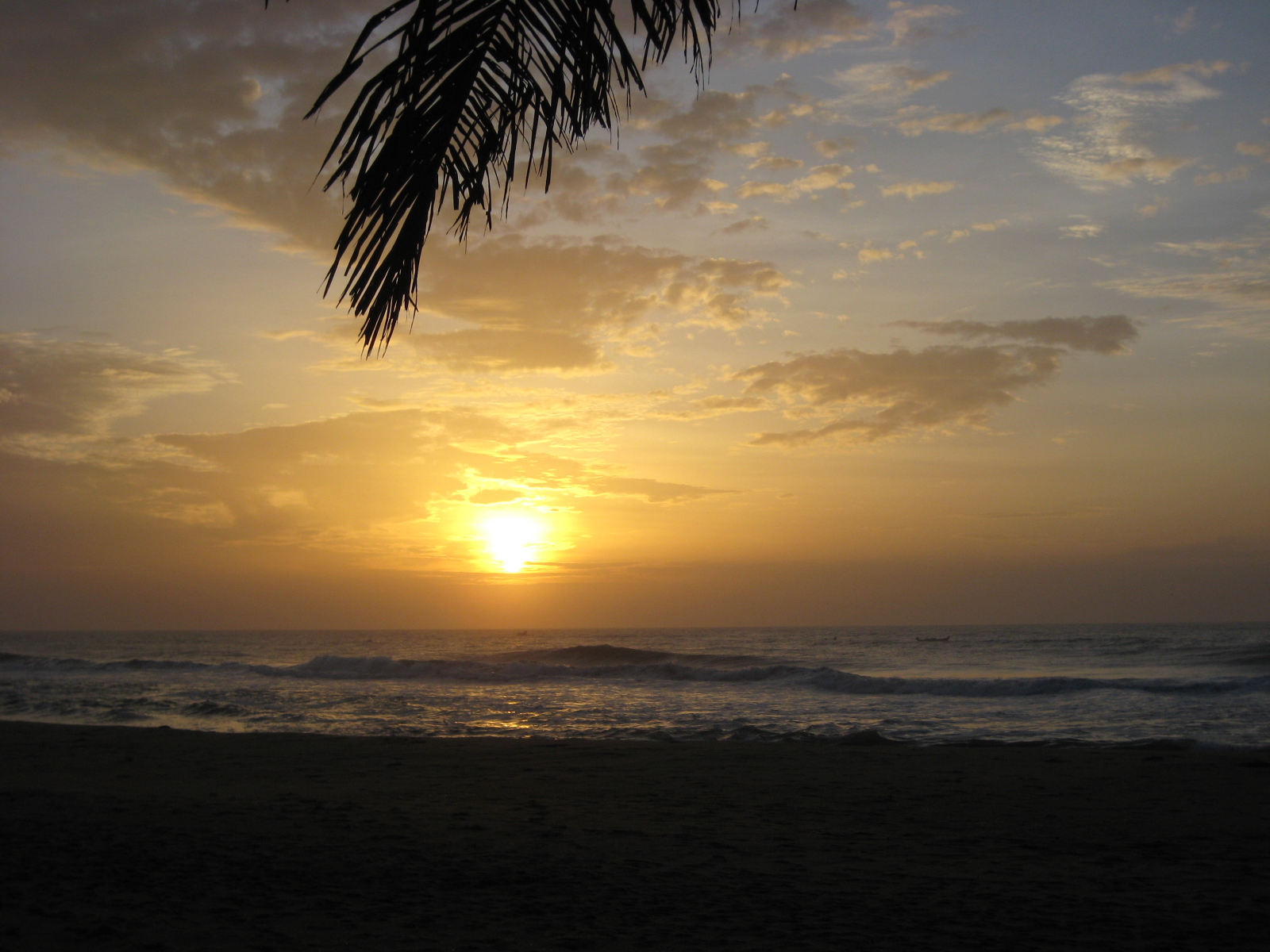
At last we arrived at the Ideal Beach Resort, a very comfortable (and relatively pricey) place about 4 km north of Mahabalipuram, about which more below. The IBR is popular with European tourists but seems to attract few Americans. Indeed there are few American in these America-remote parts. But for those who get here, the IBR is perfect for sleeping off time changes and easing into South Indian culinary delights. Here is a morning view (we're on the east coast, remember) over the Bay of Bengal.
Mahabalipuram is a wonderful temple city just down the coast --- indeed, walkable along the beach from the IBR. The temples and carvings date from the Pallava dynasty, around 700 CE. The shore temple along the beach is, according to our guide, just one of five similar complexes, the other four having been washed out to sea over the centuries. What remains is now protected by a (modern) sea wall.
Here are two views of the seaside temple complex, now somewhat eroded by wind, water, and sand. Inscriptions in some presumably pre-Tamil characters are faintly visible here and there. According to our guide these inscriptions run right to left, unlike Tamil, but I'm dubious. The structures are mainly of sandstone, but some details are in a harder, darker black granite, which retains more sculptural detail after 1300 years.


Elsewhere in Mahabalipuram town are several other sculptural sites, contemporary with the shore temple but a little inland and hence much less weathered. One of the most spectacular is the Five Rathas. All five house-like structures and several animal figures were supposedly carved, not built up, from one immense rock outcropping.

The Five Rathas site points to a story in the Mahabharatha. The famously beautiful and floral-smelling Draupadi married five noble brothers, the Pandavas, who collectively (individually would be asking too much) embodied five important husbandly virtues.
Here is Draupadi among her husbands.

At yet another site in Mahabalipuram are very detailed bas-relief carvings, in solid rock, of episodes from the Hindu scriptures. The scene below involves Krishna, cows, and a great many female cowherds.

The carvings are intricate and charming, with elephants, monkeys, rabbits, snakes, and mythical creatures.

The emaciated chap with arms aloft is one of the five Pandava brothers, undergoing a 12-year ascetic period at the instruction of Siva, shown to his right. In the possibly satirical picture below the Pandava ascetic is replaced by a rabbit, and Siva by a buxom snake-woman hybrid.
 | |||||||||||

Nearby is an immense balanced rock, supposedly ancient and known locally as Krishna's Butterball. But for my daughter's Sisyphean effort it might roll down the hill.


